Tuesday, February 17, 2015

JSF 2.x Tip of the Day: Implementing a ViewMapListener

A map of the lands where the Trobadors flourished. 
"France 1154-en" by Reigen - Own work
Licensed under CC BY-SA 4.0 via Wikimedia Commons.

Introduction

There are a number of SystemEvents supported by JSF 2.x. A question that comes up frequently is how to implement them. In a number of cases on stackoverflow, it is implemented using a PhaseListener. I was looking for a way to cleanup the view map, or just get values from it before it was destroyed. I decided that the simplest way to do so was to implement a ViewMapListener. I also noticed that there were very few posts on how to implement it using the faces-config.xml so I decided to use that approach since it was instructive and more clear to me.

Implementation

The basic implementation requires that you add our listener implementation to the faces-config.xml. The example I have here is designed to get called on a PreDestroyViewMapEvent which is called on a normal navigation. We can force it though by adding a @PreDestroy annotation to a method to invoke before being destroyed. Inside the method we would need to get the UIViewroot view map, and call clear(). This would cause our listener to be invoked too. It would be a good cleanup mechanism for cleaning up resources on session expiration too, but at the moment this does not work on JSF 2.1. The @PreDestroy is not called on session timeout on JSF 2.1. This is expected to be an enhancement in JSF 2.2+.

The code for the project can be downloaded from Bitbuket here: viewmaplistener-example

Conclusion

The example above is just one mechanism of using a SystemEvent listener. You may decide to read values from the map, and add them to the session, or manipulate it in some other way before the data is destroyed.

Friday, December 26, 2014

ExecutorService Conundrum

I was asked by someone to solve a problem with threads that they were having. They wanted to cancel a Future that was sent to an ExecutorService. I told them to look at a previous posts I had done on the subject. However, they insisted that this was different. So I took a look at the code. Alas, it was slightly different, but like most folks including me, they were too close to the problem to see the answer. I looked at it, and at first glance I thought something was askew, but it was not.

The code for this project can be downloaded here: runnable-example
As you can see from the results of the run, the future is canceled, but still keeps running. Then it gets interrupted, and breaks. So the question is why is it still running after being canceled.

Here is the Runnable and the main class to execute it:

MyRunnable.java


Main.java


So the do you have an answer? The answer is at the bottom of the blog. Don't peek... think!

Reference

Answer

Simply because you have canceled it, and even interrupted it; it is still a running thread. It is not scheduled, so you are not canceling it before execution.

Sunday, December 21, 2014

JSF 2.x Dynamic Encoding

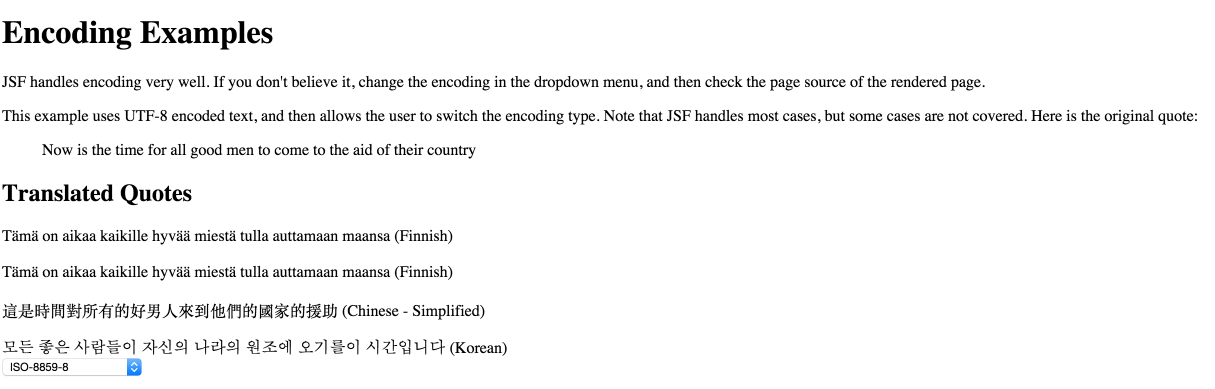
Encoding Examples
In an Internationalized world, we need to be able to change the encoding of a JSF page dynamically. In this case, we have some characters encoded in UTF-8, but we want to be able to change the encoding on the page, and have the framework handle the character conversions for our web page.

So how do we do it?

One of the simplest ways is to wrap our page in a <f:view /> tag. The tag wraps the <head/> and <body/> elements in our HTML page. In the example above this is accomplished as shown below: The code for the backing bean is shown below:

EncodingBean.java


The Netbeans Maven project can be found here: JSF Dynamic Encoding

Popular Posts